Once cured, Urushi possesses remarkable physical properties rarely combined in a single material:
•Waterproof and corrosion-resistant
• Resistant to acids, alcohol, and alkalis
• Withstands temperatures up to 300°C
• Extremely durable and long-lasting
However, it is not invincible:
• Sensitive to UV degradation
• Can develop micro-cracks over long exposure to sunlight
This duality—strength and fragility—defines its poetic nature.
⸻
Refinement: From Sap to Noble Material
Raw Urushi is never used directly without transformation.
Key refining processes:
Nayashi (撹拌・精製)
• Continuous stirring and kneading
• Breaks down particles
• Improves smoothness and uniformity
Kurome (黒目)
• Gentle heating (~40°C)
• Reduces water content from ~30% to ~3%
• Enhances transparency and strength
These processes are rarely discussed in detail but are critical:
they define the quality, depth, and final optical behavior of the lacquer.
⸻
The Furo: A Microclimate for Transformation
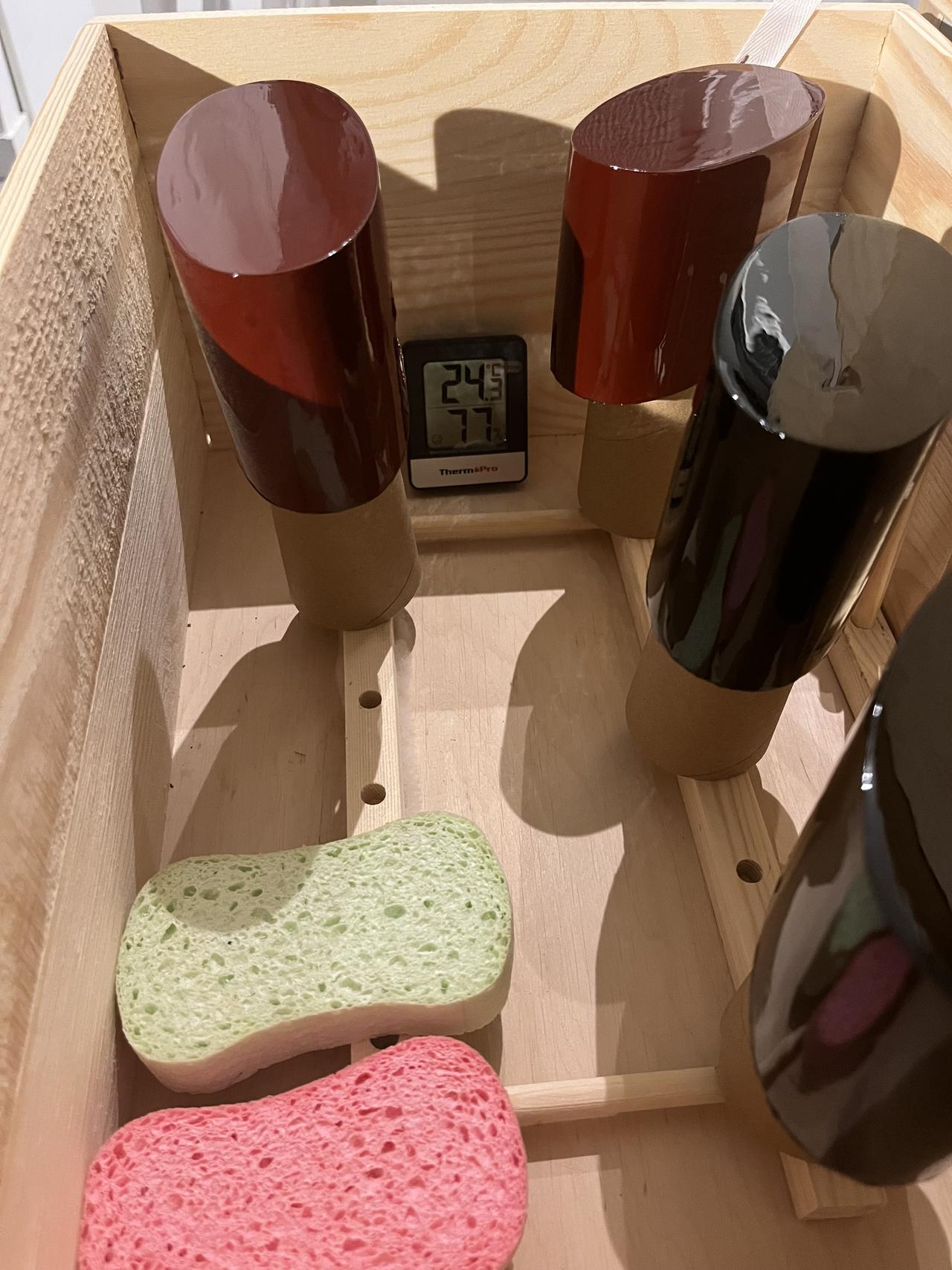
Urushi does not dry—it cures in a controlled environment.
The furo (風呂) is a humidity chamber, traditionally made of hinoki wood.
• Maintains 80–90% humidity
• Encourages polymerization
• Prevents surface drying before internal curing
This is a subtle but essential point
- If Urushi dries too quickly, it fail
- It must remain alive long enough to transform.
⸻
Layering and Construction of Urushi
Urushi is not applied according to a single fixed sequence, but through a structured process traditionally divided into three main stages:
Foundation — Shitaji (下地)
The term shitaji refers to the entire groundwork of the object. This stage is essential and often the most time-consuming.
It includes:
• Surface preparation
• Reinforcement of joints or weak areas
• Application of mixtures such as urushi combined with clay powders (e.g. tonoko or jinoko)
The purpose of shitaji is not decorative, but structural: it creates a stable, even, and durable base capable of receiving lacquer layers.
⸻
Intermediate Coating — Nakanuri / Chūnuri (中塗り)
This stage consists of one or several intermediate lacquer applications.
The role of nakanuri is to:
• Refine and unify the surface
• Eliminate irregularities from the foundation
• Prepare the object for the final coat
At this stage, the surface is often carefully leveled through controlled abrasion.